
Understanding the correct format for bank details is essential for businesses and individuals managing financial transactions in 2026. Whether you're setting up direct deposits, processing international wire transfers, or reconciling accounts with your accounting software, having accurate bank information in the proper format prevents costly errors and delays. This comprehensive guide covers the standard formats used across domestic and international banking systems, helping you navigate the complexities of modern financial data management.
Understanding Standard Bank Account Information
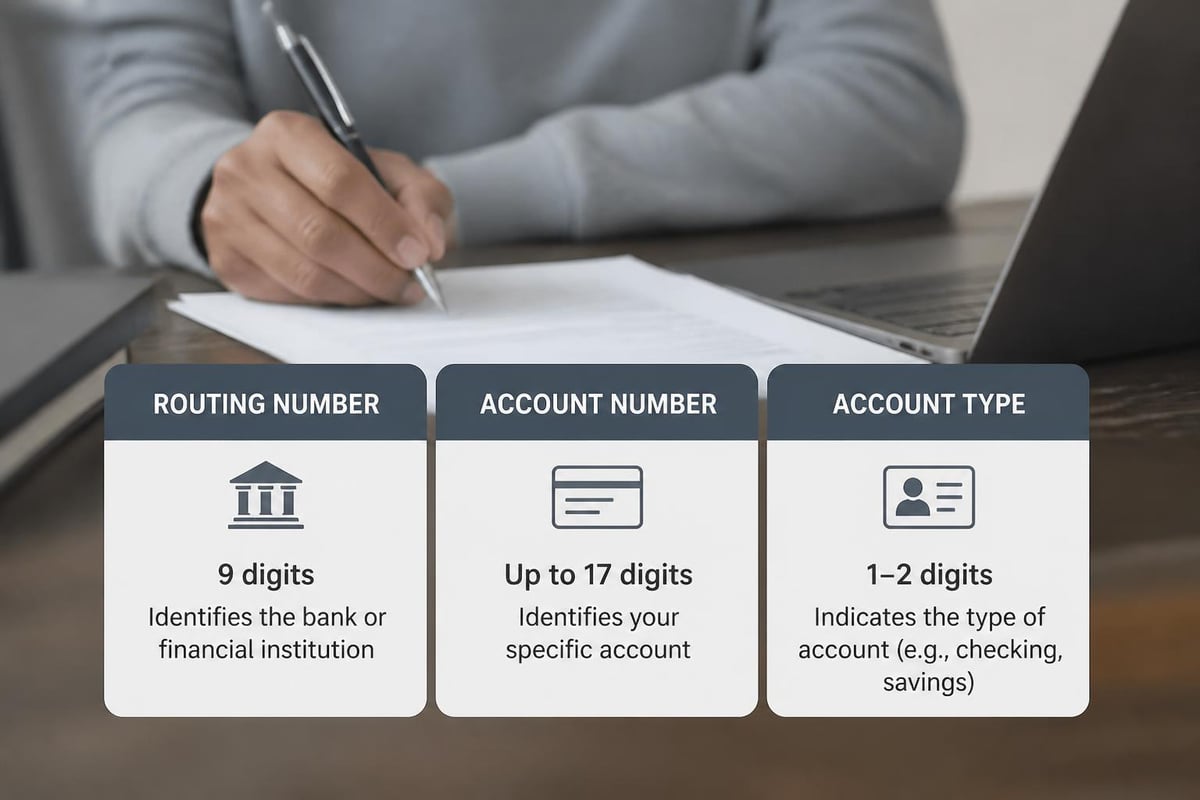
The format for bank details varies significantly depending on your location and the type of transaction you're conducting. In the United States, domestic transactions typically require three primary pieces of information: the bank's routing number, your account number, and the account type. Each of these elements serves a specific purpose in identifying where funds should be directed.
Routing numbers consist of nine digits that identify the financial institution. The first four digits represent the Federal Reserve routing symbol, the next four identify the specific bank, and the final digit serves as a check digit for validation purposes. This standardized format ensures that automated clearing house (ACH) transactions reach the correct institution without manual intervention.
Account Number Formatting Standards
Account numbers in the United States typically range from 8 to 12 digits, though some institutions use longer sequences. Unlike routing numbers, account number formats lack universal standardization across financial institutions. Each bank determines its own numbering system, which may include:
- Branch identifiers embedded within the number
- Account type indicators
- Check digits for validation
- Sequential customer identification numbers
Understanding your specific institution's format becomes particularly important when you need to extract and organize this information for record-keeping. Many businesses working with bank statement format in PDF need to accurately capture these details for accounting purposes.
International Bank Detail Formats
When conducting cross-border transactions, the format for bank details becomes more complex. The International Bank Account Number (IBAN) serves as the global standard for identifying bank accounts across borders. This standardized format for international transactions helps reduce errors and processing delays in international payments.
IBAN Structure and Components
The IBAN consists of up to 34 alphanumeric characters, organized in a specific sequence that varies by country. Every IBAN begins with a two-letter country code, followed by two check digits, and then the Basic Bank Account Number (BBAN) which includes the domestic bank account information.
| IBAN Component | Description | Example |
|---|---|---|
| Country Code | Two-letter ISO code | GB, DE, FR |
| Check Digits | Validation numbers | 29, 89, 14 |
| Bank Code | Institution identifier | 4-8 characters |
| Account Number | Customer account | Varies by country |
The detailed structure of the IBAN ensures that each element can be validated independently, reducing the likelihood of payment errors. For instance, a German IBAN contains 22 characters, while a British IBAN uses 22 characters, and a French IBAN requires 27 characters.
SWIFT/BIC Codes in Bank Details
Beyond the IBAN, international transfers require the SWIFT code (also known as BIC - Bank Identifier Code). This 8 to 11-character code identifies the specific financial institution and branch involved in the transaction. The format for bank details in international contexts must include both the IBAN and SWIFT code for successful processing.
SWIFT codes follow this structure:
- First 4 characters: Bank code (letters only)
- Next 2 characters: Country code (letters only)
- Next 2 characters: Location code (letters and digits)
- Last 3 characters: Branch code (optional, letters and digits)
Formatting Bank Details for Business Use
Businesses require a consistent format for bank details to streamline payment processing, vendor management, and financial reporting. Establishing standardized templates ensures that all necessary information is captured accurately every time you add a new payee or update existing records.
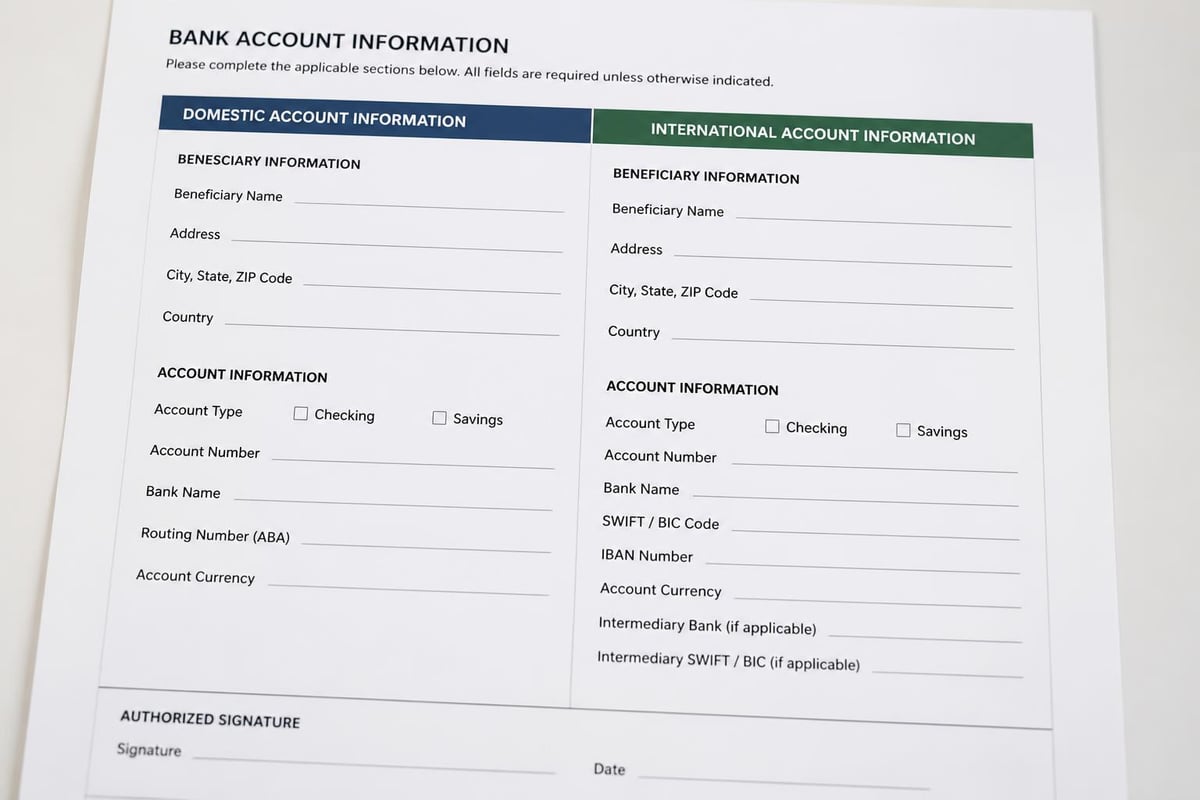
A comprehensive business bank details format should include:
- Beneficiary Name: Legal name of the account holder exactly as registered
- Bank Name: Full legal name of the financial institution
- Account Number: Complete account number without spaces or special characters
- Routing/Sort Code: Appropriate domestic routing identifier
- IBAN: For international payments (if applicable)
- SWIFT/BIC: For international transfers
- Bank Address: Physical address of the institution or branch
- Account Type: Checking, savings, or other designation
Digital Format Considerations
When storing bank details digitally, format consistency becomes critical for data integration with accounting platforms. Many businesses convert their PDF bank statements to usable spreadsheets to maintain organized financial records that integrate seamlessly with their accounting systems.
Best practices for digital formatting include:
- Remove all spaces and special characters from numeric fields
- Use consistent capitalization for text fields
- Validate routing and account numbers before entry
- Store IBAN and SWIFT codes in separate, clearly labeled fields
- Maintain audit trails of when bank details were last updated
Organizations working with The Analytics Doctor often implement automated validation formulas in their spreadsheets to catch formatting errors before they cause payment failures.
Regional Variations in Bank Detail Formats
The format for bank details differs substantially across regions, reflecting each country's unique banking infrastructure. Understanding these variations prevents errors when working with international suppliers, clients, or subsidiaries.
North American Formats
United States and Canadian banks use different systems despite their geographic proximity. US institutions rely on the nine-digit ABA routing number system, while Canadian banks use an eight-digit institution and transit number combination. Mexican banks have adopted the CLABE (Clave Bancaria Estandarizada) system, which uses 18 digits to identify accounts.
European Formats
European countries have largely standardized around the IBAN system, but the underlying account number structures vary significantly. Understanding IBAN components helps ensure accurate formatting when dealing with European partners. British sort codes consist of six digits formatted as three pairs (12-34-56), while German bank codes (Bankleitzahl) use eight digits.
Asia-Pacific Formats
Asian banking systems employ diverse formats. Japanese banks use a combination of four-digit bank codes and three-digit branch codes. Australian banks utilize BSB (Bank-State-Branch) numbers consisting of six digits. Indian financial institutions use IFSC (Indian Financial System Code) with 11 alphanumeric characters.
| Region | Primary Identifier | Format Length | Example Structure |
|---|---|---|---|
| USA | Routing Number | 9 digits | 123456789 |
| UK | Sort Code | 6 digits | 12-34-56 |
| Germany | Bankleitzahl | 8 digits | 12345678 |
| Australia | BSB | 6 digits | 123-456 |
Data Security in Bank Detail Management
Protecting the format for bank details goes beyond accuracy; it requires robust security measures. Bank account information represents sensitive data that requires encryption, access controls, and secure transmission protocols. When storing or transmitting bank details, businesses should implement industry-standard security practices.
Key security considerations include:
- Encryption at rest: Store bank details in encrypted databases
- Encryption in transit: Use TLS/SSL for all data transmission
- Access controls: Limit who can view or modify bank information
- Audit logging: Track all access and changes to bank details
- Tokenization: Replace sensitive data with non-sensitive equivalents where possible
Organizations concerned about security in financial data handling should ensure their systems meet or exceed bank-level security standards, particularly when working with automated conversion tools or cloud-based accounting platforms.
Compliance and Regulatory Requirements
Different jurisdictions impose specific requirements on how businesses collect, store, and use bank account information. The Payment Card Industry Data Security Standard (PCI DSS), while primarily focused on card data, establishes security principles applicable to all financial information. The General Data Protection Regulation (GDPR) in Europe and various state privacy laws in the United States mandate specific protections for personal financial data.
Validating Bank Detail Formats
Before processing any transaction, validating the format for bank details prevents costly errors and failed payments. Different validation techniques apply to different components of bank information.
Algorithmic Validation
Most bank identifiers incorporate check digits that can be validated algorithmically. Routing numbers use the following formula:
- Multiply digits 1, 4, and 7 by 3
- Multiply digits 2, 5, and 8 by 7
- Multiply digits 3 and 6 by 1
- Sum all products
- Add digit 9 to the sum
- Result must be divisible by 10
IBAN validation uses the mod-97 algorithm, which involves rearranging the IBAN, converting letters to numbers, and calculating a modulo 97 remainder that should equal 1 for valid IBANs.

Practical Validation Steps
Beyond mathematical validation, practical verification includes:
- Format matching: Ensuring the number of digits matches the expected format
- Institution lookup: Verifying the routing number or bank code exists in official registries
- Account verification: Using micro-deposits or instant verification services
- Beneficiary confirmation: Matching account holder names with intended recipients
Common Formatting Errors and Solutions
Even with careful attention, formatting errors frequently occur when collecting or entering bank details. Recognizing common mistakes helps establish preventive measures.
Typical formatting errors include:
- Adding spaces or hyphens where systems expect continuous digits
- Confusing routing numbers with account numbers
- Using domestic formats for international transactions
- Transposing digits during manual entry
- Including leading zeros inconsistently
- Mixing up IBAN and SWIFT codes
Prevention strategies involve implementing data validation rules at the point of entry, using dropdown menus for standardized fields like country codes, and providing clear examples of correct formatting. Many organizations find that reviewing checking statements regularly helps identify and correct recurring formatting issues in their financial records.
Integration with Accounting Systems
Modern accounting platforms require bank details in specific formats for automatic reconciliation and payment processing. Understanding how your accounting software expects data formatted prevents integration issues and manual corrections.
Format Requirements by Platform
Different accounting systems have varying requirements:
- QuickBooks: Expects routing numbers without spaces, account numbers as continuous digits
- Xero: Accepts various international formats but requires country-specific configuration
- Sage: Uses separate fields for sort codes and account numbers in UK format
- FreshBooks: Supports both ACH and international wire formats
When preparing financial data for import, ensuring the format for bank details matches your platform's specifications eliminates rejection errors. Account detail and formatting standards vary across institutions, making standardization during data conversion particularly important.
API Integration Considerations
Businesses using APIs for payment processing must format bank details according to the provider's specifications. Most payment APIs expect JSON or XML formatted data with specific field names and data types. Routing numbers might be labeled as "routing_number," "aba," or "transit_number" depending on the provider.
Template Creation for Bank Details
Creating standardized templates ensures consistency in how your organization collects and stores bank information. Templates should accommodate both domestic and international requirements while remaining user-friendly.
Essential template elements:
| Field Name | Required For | Format Notes |
|---|---|---|
| Account Holder Name | All | Exact legal name |
| Account Number | All | No spaces or special characters |
| Routing Number | US Domestic | 9 digits |
| IBAN | International | Up to 34 alphanumeric |
| SWIFT/BIC | International | 8 or 11 characters |
| Bank Name | All | Full legal name |
| Bank Address | International | Complete physical address |
| Currency | International | ISO 4217 code |
Templates should include clear instructions for each field, examples of correct formatting, and validation rules that prevent common errors. Digital templates can incorporate dropdown menus, conditional formatting, and automatic validation to guide users toward correct data entry.
Managing Multiple Bank Account Formats
Organizations operating across multiple countries must manage various bank detail formats simultaneously. This complexity requires systematic approaches to ensure accuracy while maintaining efficiency.
Strategies for multi-format management:
- Centralized database design: Create a unified structure that accommodates all regional variations
- Country-specific forms: Use appropriate input forms based on the beneficiary's location
- Automated format conversion: Implement rules that translate between formats when necessary
- Regular validation: Schedule periodic reviews of stored bank details for accuracy
- Documentation standards: Maintain clear records of which format applies to each relationship
Organizations managing extensive financial data often benefit from specialized tools that handle format variations automatically while maintaining data integrity across systems.
Future Trends in Bank Detail Formatting
The financial industry continues evolving toward greater standardization and real-time verification. Emerging technologies and regulatory initiatives are shaping how bank details will be formatted and validated in the coming years.
Emerging developments include:
- Instant payment networks: Requiring real-time account validation and faster format verification
- Blockchain-based identifiers: Exploring cryptographic alternatives to traditional account numbers
- Biometric linking: Connecting bank accounts to biometric identifiers for enhanced security
- Universal payment identifiers: Developing alternatives to traditional bank details for consumer transactions
- API-first architectures: Standardizing how systems exchange and validate bank information
These trends suggest that while current format standards will remain relevant, businesses should design their systems with flexibility to accommodate emerging identification methods.
Mastering the format for bank details ensures accurate financial transactions and seamless integration with modern accounting systems. Understanding regional variations, implementing proper validation, and maintaining strong security practices protects your organization from errors and fraud.
Bank Statement Boss helps businesses maintain accurate financial records by converting PDF bank statements into properly formatted spreadsheets with 99% accuracy. Our AI-powered service ensures your bank details are captured correctly and formatted for seamless integration with your accounting platform, all while maintaining bank-level security for your sensitive financial data.