
A 3 month bank statement represents three consecutive months of financial activity in your account, providing a comprehensive snapshot of your income patterns, spending habits, and overall financial stability. Financial institutions, visa authorities, and other organizations frequently request this documentation to verify your economic standing and assess your ability to meet financial obligations. Whether you're applying for a mortgage, seeking a business loan, or planning international travel, understanding how to prepare and present your 3 month bank statement can significantly impact your approval chances.
Why Organizations Request a 3 Month Bank Statement
Financial institutions and government agencies request three months of statements rather than a single month to identify patterns and verify consistency. One month might show unusual activity that doesn't reflect your typical financial situation, but three months reveal whether your income is stable, your expenses are manageable, and your account maintains positive balances.
Mortgage Applications and Lending Requirements
Mortgage lenders typically require 2-3 months of bank statements to verify that borrowers have sufficient funds for down payments and closing costs. The three-month period helps underwriters confirm that large deposits aren't borrowed money and that your income stream can support monthly mortgage payments.
Key elements lenders examine include:
- Consistent paycheck deposits matching stated income
- Sufficient reserves for emergencies
- Debt payment patterns and timing
- Overdraft frequency or absence
- Large unexplained deposits requiring documentation
Traditional W-2 employees face straightforward verification processes, but self-employed borrowers often encounter more scrutiny. Three-month bank statement loans specifically cater to business owners and freelancers who lack conventional pay stubs, using deposit patterns to calculate qualifying income.

Immigration and Visa Applications
When applying for international visas, particularly Schengen visa applications, embassies require a 3 month bank statement to confirm you can financially support yourself during your stay. Consular officers look for stable balances demonstrating you won't become a financial burden on the host country.
The three-month period proves that your account maintains consistent activity rather than showing a temporary influx of funds deposited solely for visa purposes. Immigration authorities want evidence of regular income sources and spending patterns that align with your stated occupation and travel plans.
| Visa Type | Typical Minimum Balance | Additional Requirements |
|---|---|---|
| Schengen Tourist | €3,000-€5,000 | Flight reservations, hotel bookings |
| US B1/B2 | $5,000-$10,000 | Employment letter, property ownership |
| UK Standard Visitor | £3,000-£5,000 | Ties to home country proof |
What Information a 3 Month Bank Statement Contains
Bank statements provide detailed records of every transaction flowing through your account, organized chronologically with running balances. Understanding what appears on these documents helps you prepare clean, professional statements for submission.
Essential Components and Transaction Details
Every bank statement includes your personal information, account number, statement period dates, and beginning and ending balances. Between these bookends, you'll find comprehensive transaction listings showing dates, descriptions, amounts, and resulting balances after each activity.
Standard statement elements include:
- Deposit records: Direct deposits, check deposits, transfers in, and interest earned
- Withdrawal records: Checks written, ATM withdrawals, debit card purchases, and automatic payments
- Fee documentation: Monthly maintenance fees, overdraft charges, and service fees
- Interest calculations: Rate information and monthly accrual amounts
Financial institutions generate these statements monthly, making it simple to gather the three consecutive months typically required. If you manage multiple accounts, you may need to provide statements for checking accounts, savings accounts, and investment accounts depending on the application requirements.
Digital vs. Paper Statement Formats
Most banks now offer digital statements as the default delivery method, providing PDF documents through online banking portals. These electronic versions contain identical information to paper statements while offering easier storage and retrieval. When you need to request specific statement periods, most institutions allow downloads of up to seven years of historical statements.
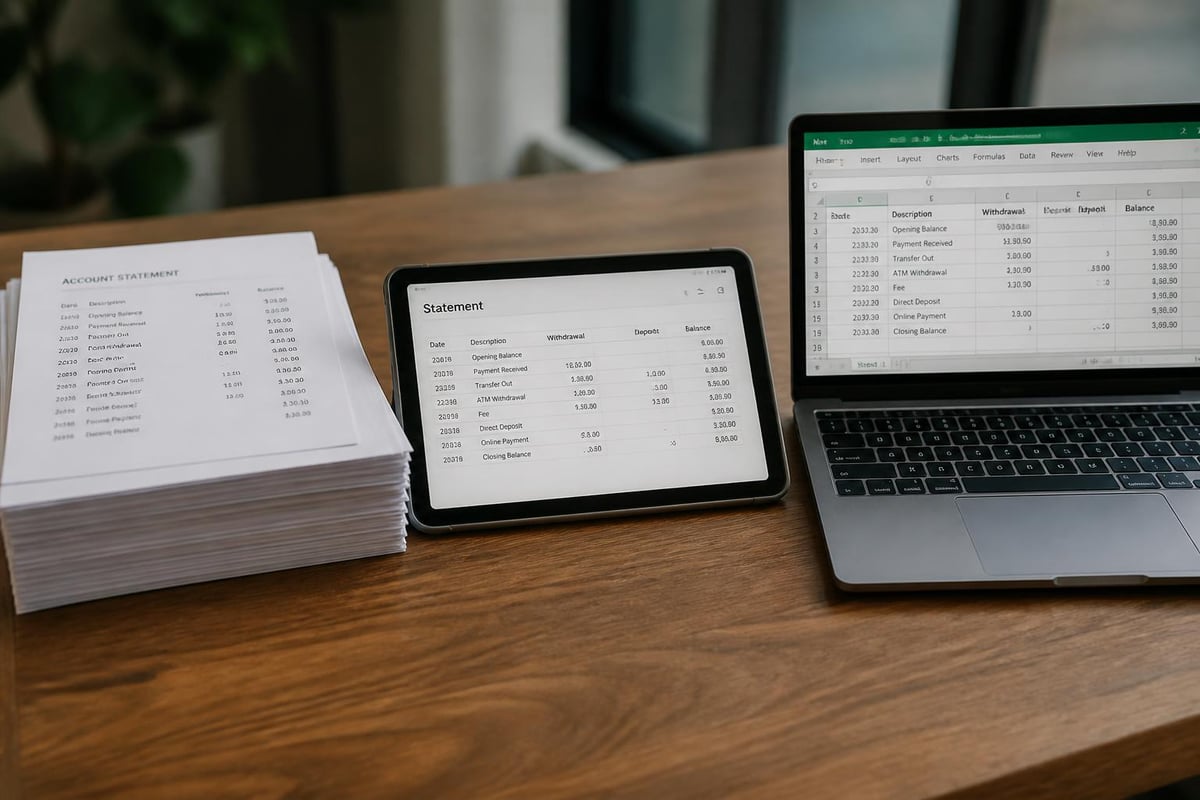
The PDF format presents challenges when you need to analyze data, calculate totals, or import transactions into accounting software. Converting these documents into spreadsheets enables better financial analysis and seamless integration with budgeting tools.
How to Prepare Your 3 Month Bank Statement for Submission
Proper preparation of your bank statements can make the difference between smooth approval and frustrating delays. Organizations reviewing your financial documents expect complete, unaltered statements with clear transaction histories that support your stated financial position.
Gathering Complete Documentation
Start by identifying which accounts require documentation. If you receive income into multiple accounts or maintain separate business and personal banking, clarify which statements the requesting organization needs. Most applications specify "all accounts" or "accounts showing income and assets."
Download or request statements for the exact three-month period specified. If today's date is May 10, 2026, and you need three months of statements, determine whether the requirement means March, April, and May 2026, or if it means the three most recent complete monthly cycles.
Preparation checklist:
- Verify statement dates cover the full required period
- Ensure all pages are included (statements often span multiple pages)
- Check that account numbers and personal information are legible
- Confirm transactions are visible without redaction
- Organize statements chronologically (oldest to newest)
Handling Sensitive Information and Privacy
While you must provide genuine, unaltered statements, you may wonder about protecting sensitive information. Generally, financial institutions and government agencies require complete, unredacted statements. However, some lenders allow minimal redaction of specific transaction details unrelated to the application purpose.
Never alter balances, dates, or deposit amounts. Such modifications constitute fraud and will result in immediate application denial plus potential legal consequences. If certain transactions raise privacy concerns, contact the requesting organization to ask about their redaction policies before making any changes.
Common Issues That Delay 3 Month Bank Statement Processing
Even when you submit the correct documents, certain red flags can trigger additional scrutiny or requests for clarification. Understanding what reviewers look for helps you proactively address potential concerns.
Unexplained Large Deposits
Any deposit significantly larger than your regular income pattern will require explanation. Lenders and visa officers assume large deposits might represent borrowed funds rather than genuine income or assets. You'll need to provide documentation showing the source of these funds.
Acceptable deposit explanations include:
- Tax refunds (supported by tax return documentation)
- Bonuses or commission payments (verified by employer letter)
- Gift funds (accompanied by gift letters from donors)
- Asset sales (proven with closing documents or receipts)
- Legitimate business revenue (supported by invoices and client payments)
Insufficient Average Balances
Visa applications and certain loan programs specify minimum average balance requirements over the three-month period. A single month with adequate funds doesn't satisfy this requirement. Reviewers calculate your average daily balance across all ninety days, meaning you can't simply deposit large sums immediately before applying.
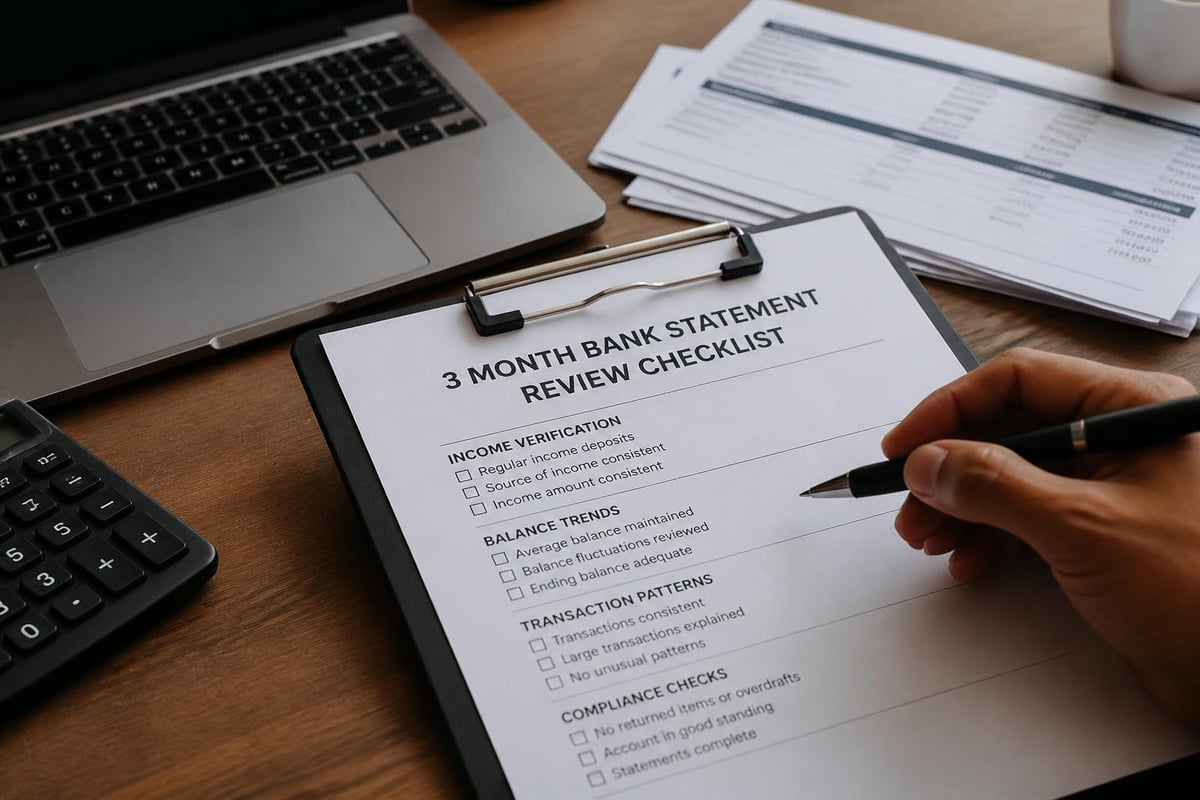
| Statement Review Factor | What Reviewers Check | Red Flags |
|---|---|---|
| Income Consistency | Regular deposit timing and amounts | Irregular or missing deposits |
| Spending Patterns | Expenses aligned with stated lifestyle | Excessive gambling, suspicious transfers |
| Account Health | Positive balances, minimal fees | Frequent overdrafts, NSF charges |
| Cash Flow | Money in exceeds money out | Declining balance trend |
Specialized Uses of 3 Month Bank Statements in 2026
Beyond traditional mortgage and visa applications, three-month statement requirements appear in various financial contexts. Each use case emphasizes different aspects of your banking history.
Business Loan Applications
Small business owners seeking financing often provide both personal and business account statements covering three months. Lenders analyze business statements for revenue trends, payment cycles from clients, and operational expense patterns. Personal statements demonstrate the owner's ability to support themselves during lean business periods.
Understanding the purpose of bank statements in business contexts helps entrepreneurs present their financial position effectively. Business statements should show consistent revenue, timely payments to suppliers, and appropriate cash reserves for operations.
Rental Applications
Landlords and property management companies increasingly require a 3 month bank statement from prospective tenants to verify income and financial responsibility. These statements supplement pay stubs by confirming that paychecks actually deposited into your account and that you maintain balances sufficient to cover rent plus living expenses.
Self-Employed Income Verification
Freelancers, contractors, and business owners face unique challenges when mortgage underwriters assess their applications. Without W-2 forms or traditional pay stubs, self-employed borrowers rely heavily on bank statement analysis to prove income.
Bank statement mortgage programs calculate qualifying income by averaging deposits over the three-month period (or longer), then applying a percentage to account for business expenses. These programs recognize that gross deposits don't equal net income for business owners.
Converting and Analyzing Your 3 Month Bank Statement
Once you've gathered your statements, you may need to analyze the data for budgeting purposes, prepare summaries for lenders, or integrate transactions into accounting systems. PDF statements, while official and acceptable for submission, limit your ability to manipulate and analyze your financial data.
The Challenge of PDF Statement Analysis
Banks issue statements in PDF format to prevent alteration and maintain document integrity. This PDF bank statement format works perfectly for archival purposes but creates obstacles when you need to calculate totals, categorize expenses, or identify spending patterns.
Manually retyping transaction data into spreadsheets consumes hours and introduces errors. For a single month with 50-100 transactions, manual entry might take 30-60 minutes. Multiply that by three months, plus the time required to verify accuracy, and the process becomes prohibitively time-consuming.
Automated Conversion Solutions
Modern technology enables rapid conversion of PDF bank statements to usable spreadsheets through AI-powered recognition systems. These tools identify transaction rows, extract dates, descriptions, and amounts, then organize the data into structured formats compatible with Excel, Google Sheets, and accounting platforms.
Automated conversion maintains accuracy while reducing processing time from hours to minutes. The resulting spreadsheets enable instant calculations of average balances, income totals, and expense categories-all information helpful when preparing financial applications or responding to underwriter questions.
Best Practices for 3 Month Bank Statement Management
Developing good statement management habits simplifies future financial applications and improves your overall financial awareness. Rather than scrambling to locate documents when deadlines approach, implement systems that keep statements organized and accessible.
Digital Organization Systems
Create a dedicated folder structure on your computer or cloud storage service specifically for financial documents. Organize by year, then by account, ensuring each statement file includes the account name and statement period in its filename (e.g., "Chase_Checking_2026-03.pdf").
Recommended folder hierarchy:
- Financial Documents (root folder)
- Bank Statements (subfolder)
- 2026 (year folder)
- Chase Checking (account folder)
- Individual monthly statement files
This organization allows instant retrieval when you need specific periods. Most applications request "the most recent three months" rather than specific dates, so maintaining current files ensures you're always prepared.
Regular Statement Review
Beyond application preparation, regularly reviewing your three-month statement history serves important financial management purposes. Bank statements help detect fraud, identify unnecessary subscriptions, and reveal spending patterns that may need adjustment.
Monthly reviews take 10-15 minutes but provide valuable insights into whether your financial habits align with your goals. When application time arrives, you'll already be familiar with your statement contents and can anticipate questions from reviewers.
Security Considerations When Sharing Bank Statements
Your bank statements contain sensitive personal information including account numbers, routing numbers, addresses, and complete transaction histories. Protecting this data while satisfying legitimate documentation requests requires careful handling.
Secure Transmission Methods
Never email bank statements using standard, unencrypted email. If an organization requests electronic submission, use their secure portal or encrypted file transfer service. Many mortgage lenders and visa processing centers provide secure upload systems designed specifically for confidential financial documents.
When mailing physical copies, use certified mail with tracking to ensure delivery confirmation. Keep copies of everything you submit, noting the date, recipient, and method of transmission.
Verification of Legitimate Requests
Scammers sometimes impersonate lenders or government agencies to collect bank statements for identity theft purposes. Before submitting your 3 month bank statement to anyone, verify you're dealing with a legitimate organization through independent research-not using contact information provided in the request itself.
Security verification steps:
- Look up the organization's official contact information independently
- Call to confirm they made the request
- Verify the specific documents needed and where to send them
- Ask about their data protection and privacy policies
- Confirm how long they'll retain your statements
Understanding bank-level security standards helps you evaluate whether document processing services and financial institutions adequately protect your sensitive information.
Troubleshooting Common 3 Month Bank Statement Problems
Despite careful preparation, you might encounter issues that threaten application deadlines or raise questions during the review process. Knowing how to address these situations quickly prevents delays.
Missing or Incomplete Statements
If you discover a gap in your statement history or find that one month is incomplete, contact your bank immediately. Most institutions can generate replacement statements quickly, though they may charge fees for statements older than a specific period.
Some online banking systems limit how many historical months you can download without assistance. If you need statements older than the available online range, call customer service or visit a branch to request archived documents.
Statements Showing Multiple Accounts
When your bank combines multiple account types on a single statement document, clarify with the requesting organization whether they need all accounts shown or just specific ones. Some lenders want only the accounts where income deposits and reserves are held, while others require complete documentation of all financial relationships.
Foreign Currency and International Statements
If you maintain accounts in foreign banks or hold accounts denominated in other currencies, you may need to provide exchange rate documentation showing USD equivalent values. Some applications specify that all statements must be translated into English by certified translators, adding time and cost to your preparation process.
Understanding what organizations look for in a 3 month bank statement and how to prepare clean, complete documentation streamlines your financial applications and demonstrates professional financial management. Whether you're pursuing mortgage approval, visa clearance, or business financing, organized statements with clear transaction histories support your credibility. Bank Statement Boss helps you quickly convert PDF statements into analyzable spreadsheet formats with 99% accuracy, enabling better financial oversight and seamless integration with accounting platforms while maintaining bank-level security for your sensitive data.