
The bank statements you receive each month contain far more than just a list of transactions. These financial documents serve as official records of your account activity, providing crucial information for budgeting, tax preparation, fraud detection, and accounting reconciliation. Whether you're a business owner managing multiple accounts or an individual tracking personal finances, understanding how to read and utilize the bank statements effectively can save time, prevent costly errors, and provide valuable financial insights. The evolution of banking technology has transformed how we access and process these documents, but their fundamental importance remains unchanged in 2026.
What the Bank Statements Actually Include
The bank statements produced by financial institutions follow standardized formats required by federal banking regulations. Each statement provides a comprehensive snapshot of account activity during a specific period, typically one month.
Essential Components Found in Every Statement
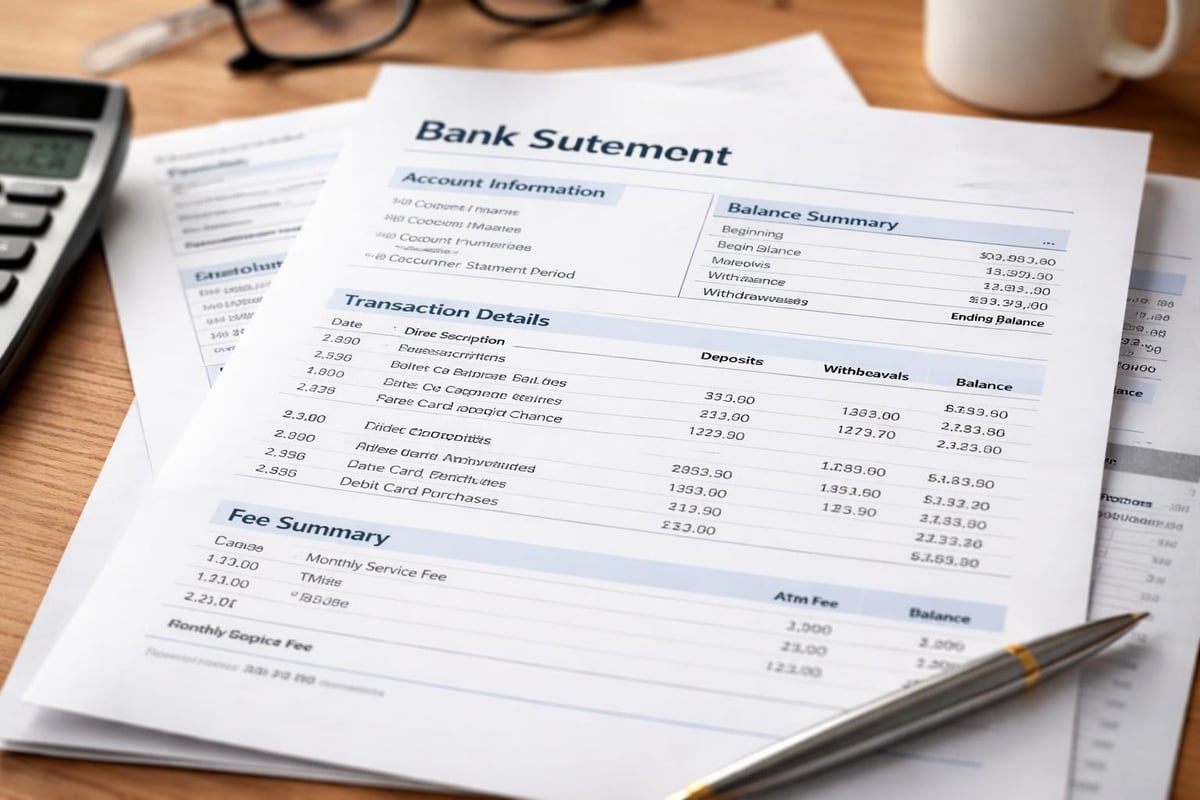
Every statement begins with basic account information, including your name, account number, statement period dates, and branch details. This header section identifies the specific account and timeframe being documented.
The opening and closing balance figures represent the most critical reference points on the bank statements. These amounts show exactly how much money was in your account at the start and end of the statement period, providing immediate visibility into whether your account grew or decreased during that time.
Transaction Details and Categorization
The transaction section forms the heart of the bank statements, listing every debit and credit that occurred during the period. Each entry typically includes:
- Transaction date and posting date
- Description or merchant name
- Reference or check number
- Debit amount (money out)
- Credit amount (money in)
- Running balance after each transaction
Understanding these transaction details helps you track exactly where money came from and where it went. Modern statements often include merchant category codes or descriptions that provide additional context about each transaction's nature.
Fees, Interest, and Additional Charges
The bank statements clearly itemize all fees assessed during the period, including monthly maintenance fees, overdraft charges, ATM fees, wire transfer costs, and foreign transaction fees. Interest earned on deposit accounts also appears as a separate line item, showing how much your balance grew through accrued interest.
| Fee Type | Common Range | When Charged |
|---|---|---|
| Monthly Maintenance | $0-$25 | If minimum balance not met |
| Overdraft Fee | $25-$35 | Per overdraft occurrence |
| ATM Fee (Out-of-Network) | $2-$5 | Per transaction |
| Wire Transfer | $15-$50 | Per outgoing wire |
| Paper Statement Fee | $1-$5 | Monthly for mailed statements |
Why Regular Review of the Bank Statements Matters
Many account holders receive the bank statements and file them away without thorough examination. This approach creates significant risks and misses valuable opportunities for financial optimization.
Fraud Detection and Unauthorized Transactions
Reviewing the bank statements within 30 to 60 days of receipt is critical for fraud protection. Most financial institutions limit liability for unauthorized transactions only if you report them within specific timeframes. By examining each transaction carefully, you can identify suspicious activity such as duplicate charges, unfamiliar merchants, or amounts that don't match your records.
According to banking security experts, consumers who regularly review the bank statements detect fraud an average of three weeks earlier than those who don't, significantly reducing potential losses.
Accounting Reconciliation for Businesses
For business owners, the bank statements serve as the foundation for accounting reconciliation. This process involves matching the transactions on the bank statements against your internal records to ensure accuracy and completeness. Reconciliation helps identify:
- Checks that haven't cleared
- Deposits in transit
- Bank errors or duplicate transactions
- Missing expense records
- Revenue that hasn't been properly recorded
The reconciliation process becomes substantially more efficient when the bank statements are available in digital formats compatible with accounting software. Converting PDF statements to spreadsheets allows for automated matching and reduces manual data entry errors. Services like Bank Statement Boss use AI technology to transform PDF bank and credit card statements into usable spreadsheet formats with 99% accuracy, making the reconciliation process faster and more reliable.

Tax Preparation and Documentation
The bank statements provide essential documentation for tax purposes, particularly for business owners and self-employed individuals. These documents verify income deposits, deductible expenses, and estimated tax payments. During audits, the bank statements serve as third-party verification of financial activity.
Tax professionals specifically request the bank statements to:
- Verify reported income matches actual deposits
- Confirm business expense deductions
- Track estimated quarterly tax payments
- Document charitable contributions
- Prove business mileage and travel expenses
How to Access and Organize the Bank Statements
The method for accessing the bank statements has evolved significantly with digital banking technology, though the content remains largely consistent across delivery methods.
Digital vs. Paper Statement Options
Most financial institutions now offer electronic statements as the default option, with paper statements available upon request (often for an additional fee). Electronic statements provide several advantages:
Digital Statement Benefits:
- Instant access without waiting for mail delivery
- Searchable transaction history
- Environmentally friendly option
- Often available for longer historical periods
- No risk of loss or theft during mail delivery
Paper Statement Considerations:
- Physical backup for critical records
- No dependency on technology access
- Preferred by some tax professionals
- May incur monthly fees
Best Practices for Statement Organization
Maintaining organized records of the bank statements simplifies financial management and provides quick access when needed. Financial advisors recommend implementing a systematic approach to statement storage.
For digital statements, create a dedicated folder structure organized by year and month. Use consistent naming conventions such as "2026-04-Checking-Statement.pdf" to enable quick searches and retrieval.
For businesses managing multiple accounts, consider organizing the bank statements by:
- Account type (checking, savings, credit card)
- Business entity or department
- Statement period
- Reconciliation status
Retention requirements vary by situation, but most financial professionals recommend keeping the bank statements for at least seven years to cover potential tax audits and legal documentation needs.
Common Issues Found on the Bank Statements
Even with automated banking systems, errors and irregularities occasionally appear on the bank statements. Recognizing these issues quickly protects your financial interests.
Duplicate Transactions and Processing Errors
Duplicate charges represent one of the most common issues on the bank statements. These occur when merchants accidentally process the same transaction twice or when technical glitches cause double-posting. While many duplicates resolve automatically within a few days, some require direct intervention with either the merchant or your financial institution.
Processing errors can also result in incorrect transaction amounts. A charge might appear for $150.00 instead of $15.00 due to decimal point errors, or a deposit might be credited to the wrong account. Catching these errors requires comparing the bank statements against your receipts and records.
Unexpected Fees and Charges
The bank statements frequently reveal fees that account holders weren't expecting. Understanding these charges helps you make informed decisions about your banking relationship.
| Unexpected Fee | Common Cause | Prevention Strategy |
|---|---|---|
| Monthly Maintenance | Minimum balance dropped | Set up balance alerts |
| Overdraft Charges | Pending transactions cleared | Link savings for overdraft protection |
| Foreign Transaction Fee | Online purchase from overseas merchant | Use cards without foreign fees |
| Minimum Balance Fee | Average daily balance too low | Choose accounts matching your balance |
| Dormant Account Fee | No activity for extended period | Make small deposit or withdrawal quarterly |
Timing Differences and Pending Transactions
Understanding transaction timing clarifies discrepancies between your records and the bank statements. Transactions often have different authorization dates versus settlement dates, creating confusion about when charges actually post.
Checks written near the end of a statement period may not appear until the following month's statement. Similarly, deposits made after the cutoff time might not show until the next statement cycle. These timing differences are normal but require tracking to maintain accurate balance awareness.

Extracting Maximum Value from the Bank Statements
Beyond basic transaction verification, the bank statements contain valuable data for financial analysis and planning when properly utilized.
Spending Pattern Analysis
The transaction history on the bank statements reveals spending patterns that might not be obvious from day-to-day observation. By categorizing transactions over several months, you can identify:
- Highest spending categories
- Recurring subscriptions you've forgotten about
- Seasonal spending variations
- Opportunities for cost reduction
- Cash flow patterns for business planning
Financial management platforms can analyze the bank statements to generate spending reports, but this requires getting transaction data into a usable format. Many businesses and individuals find that converting PDF statements to spreadsheets enables more sophisticated analysis without expensive software subscriptions.
Cash Flow Forecasting for Businesses
Business owners can use the bank statements to develop accurate cash flow projections. By analyzing several months of statement data, you can identify patterns in customer payment timing, seasonal revenue fluctuations, and expense cycles. This information supports better decisions about inventory purchases, hiring timing, and capital investments.
The bank statements also help verify that customer payments match invoices and that vendor charges align with purchase orders. Discrepancies might indicate billing errors, missing payments, or unauthorized charges requiring immediate attention.
Integration with Accounting Platforms
Modern accounting platforms like QuickBooks and Xero can import transaction data directly from the bank statements, automating much of the bookkeeping process. However, this functionality often requires statements in specific formats rather than standard PDF documents.
Converting the bank statements to compatible spreadsheet formats enables seamless integration with accounting software, reducing manual data entry and minimizing transcription errors. This automation proves especially valuable for businesses processing hundreds of transactions monthly.
For freelancers and independent contractors, maintaining accurate records from the bank statements simplifies income tracking and expense documentation. This becomes particularly important when working with specialized banking solutions for freelancers that may offer different statement formats.
Security Considerations When Handling the Bank Statements
The bank statements contain sensitive financial information requiring careful protection against unauthorized access and identity theft.
Secure Storage Requirements
Physical copies of the bank statements should be stored in locked filing cabinets or safes, particularly if they contain full account numbers rather than masked digits. When disposing of old statements that exceed retention requirements, use cross-cut shredders that make document reconstruction impossible.
Digital versions of the bank statements require equally rigorous protection. Store electronic statements on encrypted devices or cloud services with strong authentication requirements. Avoid saving the bank statements with obvious filenames like "bank-statement.pdf" in easily accessible folders.
Safe Sharing Practices
When you need to share the bank statements with accountants, lenders, or other authorized parties, follow secure transmission protocols. Email attachments containing the bank statements should be password-protected, with the password communicated through a separate channel.
For businesses requiring bank-level security when processing the bank statements, choose service providers that maintain appropriate data protection standards, including encryption during transmission and storage, regular security audits, and compliance with financial data handling regulations.
Digital Banking Security Features
Most financial institutions now offer enhanced security features for accessing the bank statements through online banking platforms. Enable two-factor authentication, biometric verification, and login alerts to protect against unauthorized access to your statement history.
Regularly review the access logs provided by your bank to verify that all statement downloads and views were authorized. Unusual access patterns might indicate compromised credentials requiring immediate password changes and security reviews.
Advanced Applications of the Bank Statements
Beyond basic transaction tracking, the bank statements serve specialized purposes in various financial scenarios.
Loan Applications and Underwriting
Mortgage lenders, business loan providers, and other creditors routinely request several months of the bank statements during the application process. Underwriters analyze these documents to verify income stability, assess debt-to-income ratios, and evaluate overall financial management capabilities.
The bank statements provide third-party verification that application information is accurate and complete. Lenders specifically look for:
- Consistent income deposits matching stated earnings
- Sufficient reserves beyond down payment requirements
- Absence of frequent overdrafts or returned payments
- Reasonable spending patterns relative to income
- Verification of gift funds or down payment sources
Automated Statement Analysis Tools
Financial technology has enabled sophisticated analysis of the bank statements using artificial intelligence and machine learning. Bank statement analyzers can automatically categorize transactions, identify unusual patterns, flag potential fraud, and generate financial reports without manual review.
These tools prove particularly valuable for businesses managing multiple accounts or processing high transaction volumes. Automated analysis reduces the time required to review the bank statements while improving accuracy in identifying issues requiring attention.
Forensic Accounting Applications
In legal disputes, divorce proceedings, or fraud investigations, the bank statements serve as crucial evidence of financial activity. Forensic accountants examine these documents to trace fund movements, identify hidden assets, prove income levels, or document unauthorized transactions.
The objective, third-party nature of the bank statements makes them more credible than self-reported financial records. Courts generally grant significant weight to bank statement evidence when resolving financial disputes or prosecuting financial crimes.
The bank statements represent far more than simple transaction lists-they're comprehensive financial records that support accounting accuracy, fraud prevention, tax compliance, and strategic planning. Taking time to thoroughly review and properly utilize these documents protects your financial interests while enabling data-driven decisions. Bank Statement Boss streamlines the process by converting your PDF statements into spreadsheet formats compatible with major accounting platforms, combining 99% accuracy with bank-level security to help you extract maximum value from your financial records.