
Understanding bank transaction time is essential for managing cash flow, reconciling accounts, and planning business operations. Whether you're waiting for a client payment to clear or scheduling vendor payments, the speed at which financial institutions process transactions directly impacts your ability to access and use funds. In 2026, despite technological advances, bank transaction time varies significantly based on payment method, institution policies, and processing schedules. This comprehensive guide explores the factors that determine how quickly transactions process and provides strategies for optimizing your financial workflows.
How Banks Process Daily Transactions
Financial institutions operate on structured daily cycles that dictate when they process different transaction types. Understanding when banks start processing transactions helps business owners anticipate fund availability and avoid overdrafts.
Most banks begin their processing day between 3:00 AM and 6:00 AM Eastern Time. During this window, they handle overnight transfers, update account balances, and prepare for the day's incoming transactions. This early morning processing window is when most ACH credits post to accounts, making funds available for withdrawal or additional transfers.
Transaction Posting Order
Banks follow specific hierarchies when posting transactions to accounts:
- Credits first - Deposits and incoming transfers post before debits
- Debits by amount - From largest to smallest or smallest to largest
- Electronic debits - ACH withdrawals and recurring payments
- Check transactions - Based on presentation time
The order of processing can significantly impact account balances throughout the day, especially for businesses managing tight cash flow margins. A transaction initiated at 4:00 PM might not process until the next business day, affecting your available balance differently than one submitted at 9:00 AM.

Factors That Influence Bank Transaction Time
Multiple variables affect how quickly your payments process and when funds become available. Understanding these factors helps set realistic expectations and plan accordingly.
Payment method is the primary determinant of bank transaction time. Wire transfers typically complete within hours, while ACH payments take one to three business days. Card transactions may appear pending immediately but don't settle until the next business day.
Payment Method Comparison
| Payment Type | Typical Processing Time | Cost | Best For |
|---|---|---|---|
| Wire Transfer | Same day to 24 hours | $15-$50 | Urgent, large payments |
| ACH Transfer | 1-3 business days | $0-$3 | Routine payments, payroll |
| Check Deposit | 1-5 business days | Varies | Traditional vendors |
| Card Payment | 1-2 business days | 2-3% fee | Quick transactions |
Cutoff times represent critical thresholds that determine whether your transaction processes same-day or gets pushed to the next business day. Bank transfer processing times are heavily influenced by these cutoffs, which vary by institution and transfer type.
Most banks impose ACH cutoff times between 2:00 PM and 5:00 PM local time. Submit a transfer at 4:55 PM with a 5:00 PM cutoff, and it processes that evening. Submit at 5:05 PM, and it waits until the next business day. This five-minute difference can mean a 24-hour delay in fund availability.
Weekend and Holiday Impact
Bank transaction time extends significantly when weekends or federal holidays intervene:
- Friday afternoon transactions may not process until Monday
- Transactions initiated Thursday evening before a three-day weekend won't complete until Tuesday
- Year-end holidays can create processing delays of four to five business days
The Federal Reserve recognizes eleven holidays annually, during which ACH and wire transfer systems pause operation. Planning around these dates prevents unexpected cash flow gaps.
ACH Transfers and Processing Windows
Automated Clearing House (ACH) transfers handle the majority of business-to-business payments, direct deposits, and recurring transactions. The ACH batching and fraud check process explains why these transfers traditionally require multiple business days.
ACH transactions move through the Federal Reserve network in batches rather than individually. Your bank collects ACH requests throughout the day, bundles them together, and transmits them during scheduled windows. The receiving bank then processes the incoming batch during its next cycle.
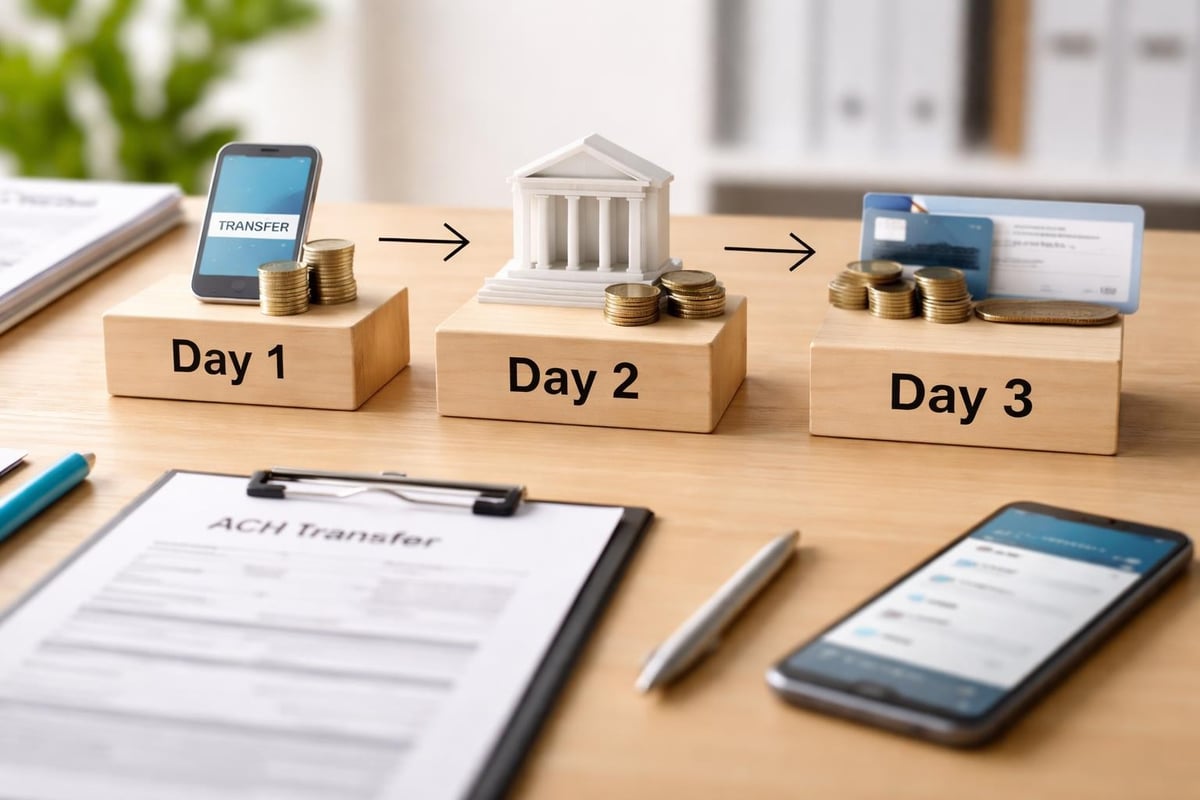
Standard ACH timing follows this pattern:
- Day 1 (Initiation): You submit the ACH transfer
- Day 2 (Processing): The ACH network processes the batch
- Day 3 (Settlement): Funds post to the recipient's account
Same-day ACH services, introduced in recent years, allow for faster processing with specific cutoff times. These typically cost slightly more but reduce bank transaction time to hours rather than days. However, dollar limits often apply to same-day ACH transfers.
Managing ACH Delays
Business owners can minimize ACH-related delays through several strategies:
- Submit transfers early in the day to meet cutoff times
- Use same-day ACH for time-sensitive payments
- Build processing time into payment schedules when planning vendor payments
- Maintain buffer balances to cover the float period
For businesses regularly reconciling accounts with PDF bank statements, understanding ACH timing helps match pending transactions to statement dates accurately.
Real-Time and Instant Payment Options
The financial industry continues evolving toward faster payment options that reduce bank transaction time substantially. These systems operate outside traditional batch processing windows, enabling near-instantaneous fund transfers.
FedNow, launched by the Federal Reserve in 2023, provides real-time payment infrastructure available 24/7/365. Unlike ACH transfers that batch process, FedNow transactions settle individually within seconds. As of 2026, adoption continues expanding across financial institutions of all sizes.
The Real-Time Payments (RTP) network, operated by The Clearing House, offers similar capabilities for instant transfers between participating banks. Both systems process payments in under 60 seconds, regardless of when they're initiated.
Comparing Payment Speed Options
Instant payment systems dramatically alter bank transaction time expectations:
- Traditional ACH: 1-3 business days
- Same-day ACH: 4-8 hours (within cutoff windows)
- Wire transfer: 2-24 hours
- FedNow/RTP: Under 60 seconds
Despite faster options, most businesses still rely primarily on standard ACH for routine transactions due to lower costs and widespread compatibility. The various timeframes for banking transactions reflect this mix of traditional and modern payment rails.
International Transfer Considerations
Cross-border payments introduce additional complexity and extended bank transaction time compared to domestic transfers. International wires typically require one to five business days, depending on destination country, correspondent banks involved, and compliance requirements.
SWIFT transfers remain the dominant method for international business payments. These move through multiple intermediary banks, each adding processing time and fees. A payment from the United States to Europe might clear in 24-48 hours, while transfers to less common destinations can take a week.
Currency conversion, anti-money laundering checks, and time zone differences all contribute to extended international bank transaction time. Some businesses now use specialized fintech platforms that offer faster, less expensive international transfers through alternative networks.
Expediting International Payments
- Provide complete, accurate beneficiary information
- Initiate transfers early in the week
- Use foreign currency accounts when possible
- Consider alternative transfer services for routine payments
- Build longer processing windows into international payment schedules
For businesses tracking international transactions across multiple accounts, maintaining accurate records through converted bank statements simplifies reconciliation despite varying processing speeds.
Transaction Holds and Availability Delays
Beyond standard processing time, banks may place holds on deposits that extend the wait for fund availability. When banks post transactions depends partly on risk assessment and regulatory requirements.
Regulation CC governs how long banks can hold funds from various deposit types:
| Deposit Type | Maximum Hold Period |
|---|---|
| Cash deposits | Next business day |
| Electronic deposits | Next business day |
| Local checks | 2 business days |
| Non-local checks | 5 business days |
| Large deposits (over $5,525) | Extended hold allowed |
New accounts face longer holds, sometimes up to nine business days for check deposits. Banks assess risk based on account history, deposit amount, and relationship length. A $50,000 check deposited to a three-month-old account will likely face maximum holds, while the same check to a ten-year account might clear in two days.

Business Impact of Processing Delays
Bank transaction time directly affects business operations, cash flow management, and financial planning. Misunderstanding processing schedules can lead to overdrafts, missed payment deadlines, and strained vendor relationships.
Cash flow gaps emerge when businesses assume immediate fund availability. A client payment initiated Friday afternoon won't clear until Tuesday at earliest, but scheduled payments might attempt to withdraw Monday morning. This creates a three-day gap requiring sufficient account balance or credit facilities.
Accounting accuracy suffers when transaction dates don't align with actual fund movement. A payment recorded as March 31 might not process until April 2, affecting monthly close procedures and financial reporting. Businesses must reconcile recorded dates with actual clearing dates.
Best Practices for Managing Transaction Timing
- Track pending transactions separately from cleared balances
- Build processing buffers into payment schedules (submit 2-3 days early)
- Monitor cutoff times for your specific financial institutions
- Maintain adequate reserves to cover float periods
- Use calendar tools that account for weekends and holidays
Understanding transaction processing variations between payment methods helps businesses choose appropriate options for different situations. Urgent vendor payments might justify wire transfer fees, while routine expenses work fine through standard ACH.
Optimizing Your Payment Workflows
Strategic planning around bank transaction time improves financial efficiency and reduces administrative burden. Businesses that align payment schedules with processing realities experience fewer cash flow surprises and smoother operations.
Establish consistent payment days that account for typical processing times. If vendors expect payment by month-end, initiate ACH transfers by the 27th to ensure timely arrival. This buffer accommodates standard processing plus potential weekend delays.
Separate urgent and routine payments into different workflow categories. Urgent items use same-day ACH or wires despite higher costs, while routine payments leverage standard ACH's lower fees. This tiered approach balances speed and economy.
Automation reduces errors and ensures timely submission before cutoff times. Scheduled recurring payments bypass manual intervention, processing consistently regardless of staff availability. However, maintain oversight to catch errors and adjust for changing circumstances.
Reconciliation Strategies
Effective reconciliation requires understanding the gap between transaction initiation and clearing:
- Record transactions at initiation date for accounting purposes
- Track clearing dates separately for cash management
- Reconcile regularly to identify discrepancies quickly
- Use pending transaction reports to monitor in-flight payments
- Convert PDF statements to spreadsheets for easier analysis and matching
For businesses managing multiple accounts or complex transaction volumes, tools that convert PDF bank statements to spreadsheets streamline the reconciliation process and improve accuracy when matching transactions across different processing timelines.
Communicating About Payment Timing
Clear communication with clients, vendors, and internal teams about bank transaction time prevents misunderstandings and maintains professional relationships. Setting appropriate expectations upfront avoids frustration when payments don't arrive instantly.
Educate clients about processing timelines when accepting payments. If you use ACH for collections, inform customers that withdrawal will occur on a specific date but may not reflect in their account for 1-2 business days. This transparency reduces disputed charges and support inquiries.
Coordinate with vendors on payment schedules that accommodate processing time. Rather than promising payment "by the 30th," specify you'll initiate the transfer by the 28th, which should arrive by the 30th barring processing delays. This approach manages expectations while maintaining reliability.
Internal teams need clear guidelines about submission deadlines. Finance staff should know exact cutoff times for different payment types and build appropriate lead time into their workflows. Document these procedures to ensure consistency across personnel changes.
Bank transaction time remains a critical factor in business financial management despite ongoing technological improvements. By understanding processing schedules, cutoff times, and the variables that affect fund availability, businesses can optimize cash flow and avoid costly mistakes. Bank Statement Boss helps you maintain accurate financial records by converting PDF bank statements into organized spreadsheets with 99% accuracy, making it easier to track transactions across different processing timelines and reconcile accounts efficiently. Take control of your financial data today and streamline your accounting workflows with bank-level security and compatibility with major accounting platforms.