
Understanding the bank statement format is essential for effective financial management, whether you're running a business, managing personal finances, or handling accounting responsibilities. A standardized bank statement format ensures consistency, readability, and compatibility across financial systems. This comprehensive guide explores the critical elements of bank statement formats, various types available, and how to leverage them for optimal financial tracking and reconciliation.
Core Components of a Standard Bank Statement Format
Every bank statement follows a structured format that presents your financial activity in an organized manner. The essential elements remain consistent across most financial institutions, though presentation styles may vary.
Account Identification Information
At the top of any bank statement format, you'll find crucial account identification details. This section typically includes:
- Account holder name and mailing address
- Account number (often partially masked for security)
- Statement period with clear start and end dates
- Bank contact information and customer service details
- Account type (checking, savings, credit card, or loan)
These identification elements serve as the foundation for organizing your financial records and ensuring you're reviewing the correct account information.
Opening and Closing Balance Section
The balance summary represents one of the most critical components of a bank statement format. This section clearly shows your financial position at the beginning and end of the statement period.
Opening balance reflects your account status at the start of the period, while closing balance shows where you stand after all transactions. The relationship between these figures, combined with total deposits and withdrawals, provides a quick snapshot of your cash flow during the statement cycle.

Transaction Details and Categorization
The transaction section forms the heart of any bank statement format. Each entry typically contains:
| Element | Description | Purpose |
|---|---|---|
| Transaction Date | When the transaction occurred | Chronological tracking |
| Post Date | When the bank processed it | Reconciliation timing |
| Description | Merchant or transaction details | Identification and categorization |
| Amount | Debit or credit value | Balance calculation |
| Running Balance | Account total after transaction | Real-time position tracking |
Modern bank statement formats often include additional categorization to help with expense tracking. Some institutions provide merchant category codes or automatic expense classifications.
Different Bank Statement Format Types and File Structures
Financial institutions provide statements in various formats, each serving different purposes and offering unique advantages. Understanding these different types of bank statements helps you choose the right format for your specific needs.
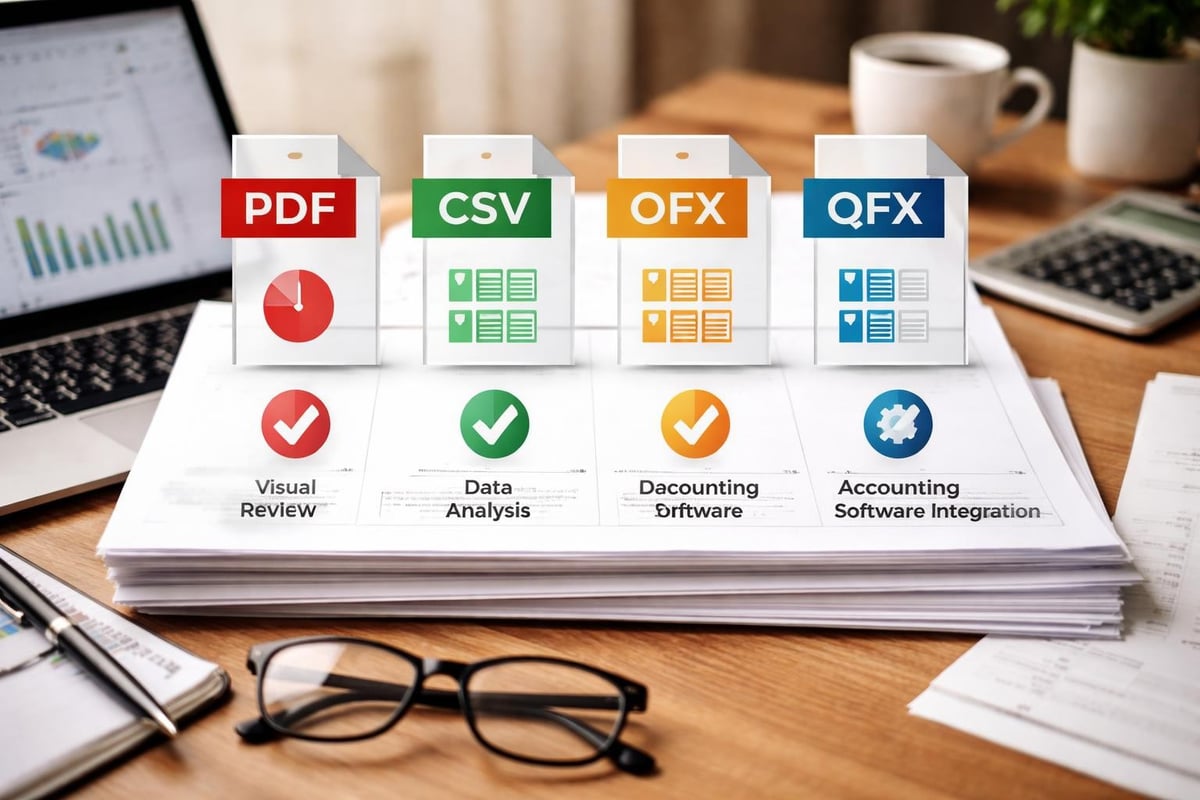
PDF Bank Statement Format
The PDF format remains the most common bank statement format distributed by financial institutions. This format preserves the visual layout exactly as designed by the bank, ensuring consistency across devices and platforms.
Key advantages of PDF statements:
- Universal readability across all devices
- Maintains original formatting and branding
- Suitable for archival and regulatory compliance
- Can be password-protected for security
However, PDF statements present challenges when you need to analyze transaction data. The information is locked in a visual format, making it difficult to sort, filter, or import into accounting software without manual data entry or conversion tools.
CSV and Spreadsheet-Based Formats
The CSV (Comma-Separated Values) format offers a data-centric approach to the bank statement format. This plain-text format organizes transaction information in rows and columns, making it immediately usable in spreadsheet applications.
CSV statements excel at:
- Direct import into accounting platforms
- Easy sorting and filtering by date, amount, or category
- Custom calculations and analysis
- Integration with business intelligence tools
- Compatibility across different software systems
The trade-off is that CSV files lack visual formatting and may require column mapping when importing into specific accounting systems.
OFX and QFX Electronic Formats
Bank statement formats like OFX and QFX represent standardized electronic banking formats designed specifically for financial software integration. Open Financial Exchange (OFX) provides a universal standard, while QFX is Intuit's proprietary variation used primarily with QuickBooks.
These formats include structured metadata that accounting software can read automatically, including:
- Transaction categorization codes
- Bank routing information
- Account type identifiers
- Statement period parameters
- Balance checkpoints
The standardization reduces manual data entry and minimizes reconciliation errors when connecting bank accounts to accounting platforms.
Industry-Specific Bank Statement Format Variations
Different account types require specialized bank statement formats tailored to their unique transaction patterns and regulatory requirements.
Business Checking Account Formats
Business bank statement formats typically include enhanced detail compared to personal accounts. These statements often feature:
- Merchant processing fees broken out separately
- Wire transfer details with originator information
- ACH batch summaries for payroll and vendor payments
- Check image thumbnails or reference numbers
- Daily balance tracking for cash flow analysis
The expanded information helps business owners and accounting professionals track operational expenses, verify vendor payments, and maintain audit trails.
Credit Card Statement Structures
Credit card statement formats differ significantly from traditional banking statements. The format emphasizes:
- Previous balance and payment received
- New purchases and cash advances
- Interest charges and fees calculation
- Minimum payment due and payment deadline
- Available credit remaining
Credit card statements also include year-to-date interest paid, which becomes essential during tax preparation for business expense documentation.
Investment and Brokerage Account Formats
Investment account statements use specialized bank statement formats that track:
| Component | Details Included |
|---|---|
| Holdings Summary | Current positions and market values |
| Transaction History | Buys, sells, dividends, and distributions |
| Performance Metrics | Returns and benchmark comparisons |
| Cost Basis Information | Purchase prices for tax reporting |
| Cash Position | Available funds for trading |
These formats must comply with regulatory requirements while providing investors with comprehensive portfolio information.
Reading and Interpreting Bank Statement Format Elements
Effective financial management requires understanding how to extract meaningful insights from your bank statement format. Beyond simply reviewing transactions, you need to recognize patterns and identify potential issues.
Identifying Recurring Transactions
Regular monthly expenses appear consistently in your bank statement format. Scanning for these patterns helps you:
- Verify subscription services are still necessary
- Detect price increases from service providers
- Ensure automatic payments processed correctly
- Budget accurately for fixed expenses
Creating a spreadsheet from your bank statement allows you to sort by merchant name or description, making recurring charges immediately visible.
Spotting Unauthorized or Erroneous Transactions
The bank statement format provides your primary tool for fraud detection and error identification. Regular review helps catch:
- Duplicate charges from merchant processing errors
- Unauthorized transactions from compromised account information
- Incorrect amounts due to system glitches
- Phantom subscriptions you forgot to cancel
Most financial institutions require you to report errors within 60 days of the statement date, making timely review essential.
Understanding Fee Structures
Banks communicate various charges through your statement format. Common fees include:
- Monthly maintenance charges
- Overdraft and insufficient fund fees
- ATM usage fees (both bank and third-party)
- Wire transfer charges
- Paper statement fees
Understanding your fee structure helps you make informed decisions about account types and banking behaviors that minimize costs.
Converting and Processing Bank Statement Formats
Many businesses and individuals need to convert bank statements from one format to another for accounting purposes. The transformation from PDF to spreadsheet format presents particular challenges and opportunities.
Manual Data Entry Challenges
Manually transcribing information from a PDF bank statement format into accounting software involves significant time investment and error risk. Each transaction requires:
- Reading the transaction date accurately
- Copying the description without typos
- Entering the amount in the correct column
- Categorizing the expense appropriately
- Verifying the entry matches the source
For statements with dozens or hundreds of transactions, this process becomes prohibitively time-consuming and prone to human error.
Automated Conversion Solutions
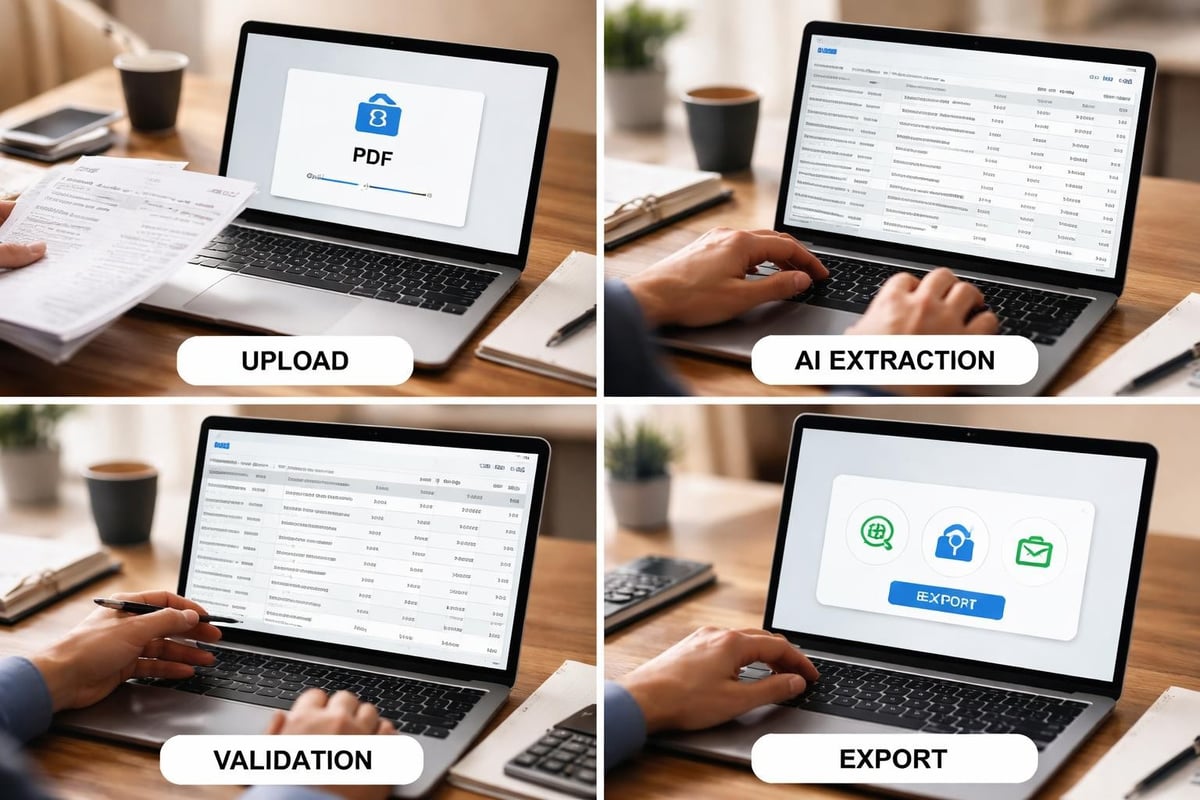
Modern technology enables automated conversion of PDF statements into usable spreadsheet formats. Services like Bank Statement Boss use AI technology to extract transaction data from PDF bank statements with exceptional accuracy, transforming locked documents into structured data compatible with major accounting platforms.
The conversion process preserves all essential elements of the bank statement format while restructuring the information for computational use. This approach saves hours of manual work while maintaining data integrity.
Data Validation and Quality Control
Regardless of conversion method, validating your extracted bank statement data ensures accuracy. Key verification steps include:
- Balance reconciliation between opening, transactions, and closing amounts
- Transaction count matching between source and converted data
- Date range verification covering the full statement period
- Special character handling for international transactions or unique descriptions
Proper validation catches conversion errors before they propagate through your accounting system.
Organizing Multiple Bank Statement Formats
Businesses often manage numerous accounts across different financial institutions, each potentially using a different bank statement format. Establishing systematic organization prevents confusion and ensures comprehensive financial oversight.
Standardized Naming Conventions
Create a consistent file naming system for saved statements:
- Include the account type (checking, savings, credit card)
- Add the institution name for multi-bank management
- Specify the statement period (usually YYYY-MM format)
- Maintain version numbers if statements are updated
Example: BusinessChecking_ChaseBank_2026-04_v1.pdf
This approach makes locating specific statements straightforward during tax preparation or audit requests.
Digital Filing Systems
Implement a folder structure that mirrors your accounting categories:
- Primary folders by year
- Subfolders by quarter or month
- Account-specific folders within time periods
- Separate folders for original PDFs versus converted spreadsheets
Cloud storage solutions provide accessibility while maintaining bank-level security through encryption and access controls.
Retention Requirements and Best Practices
Understanding how long to retain bank statements in various formats ensures compliance while managing storage efficiently:
| Statement Type | Recommended Retention |
|---|---|
| Personal checking/savings | 1-3 years |
| Business operating accounts | 7 years minimum |
| Tax-related transactions | 7 years |
| Loan and mortgage statements | Until paid plus 7 years |
| Investment statements | Until securities sold plus 7 years |
Digital storage makes extended retention practical without physical space constraints.
Bank Statement Format Standards and Compliance
Financial institutions follow specific standards when creating bank statement formats to ensure regulatory compliance and customer protection.
Regulatory Requirements
Banks must include certain elements in statement formats to comply with federal banking regulations. The Truth in Savings Act, for example, requires clear disclosure of:
- Annual Percentage Yield (APY) for deposit accounts
- Fee schedules and when charges apply
- Interest calculation methods
- Minimum balance requirements
These disclosures may appear in the statement format itself or in accompanying documentation.
Security and Privacy Considerations
Modern bank statement formats incorporate security features to protect sensitive financial information:
- Partial account number masking showing only last four digits
- Secure delivery channels through encrypted email or portal access
- Password protection options for digital statement files
- Multi-factor authentication requirements for statement access
When working with accounting platforms like Xero, ensure your bank statement handling procedures maintain these security standards throughout the conversion and import process.
Accessibility Standards
Financial institutions increasingly design bank statement formats to comply with accessibility guidelines, ensuring customers with disabilities can access their financial information. This includes:
- Screen reader compatibility for digital formats
- High-contrast text options
- Adjustable font sizes in online banking platforms
- Alternative format availability upon request
These considerations make financial information universally accessible while maintaining the integrity of the bank statement format.
Customizing Bank Statement Format for Business Needs
While banks provide standardized formats, businesses often need to adapt this information for internal reporting and analysis purposes.
Creating Executive Summary Reports
Transform detailed bank statement format data into high-level summaries for decision-makers. Key metrics include:
- Net cash flow for the period
- Largest expenses by category
- Revenue sources and deposit patterns
- Average daily balance for cash management
- Fee analysis to identify cost-saving opportunities
These summaries extract strategic insights from the granular transaction details in the standard bank statement format.
Integrating with Accounting Workflows
Effective integration between bank statement formats and accounting systems requires:
- Consistent transaction categorization aligned with your chart of accounts
- Automated reconciliation rules for recurring transactions
- Exception handling processes for unusual items
- Multi-currency support for international transactions
- Bank feed connections where available
Many businesses maintain separate bank accounts for different operational areas, requiring specialized banking solutions for freelancers and contractors to track project-specific income and expenses.
Custom Reporting Dashboards
Modern financial management extends beyond static bank statement formats to dynamic dashboards that update automatically. These systems pull data from multiple sources to provide:
- Real-time balance monitoring across all accounts
- Cash flow forecasting based on historical patterns
- Variance analysis comparing actual to budgeted amounts
- Trend identification for revenue and expense categories
- Alert systems for unusual activity or low balances
Building these capabilities requires converting static bank statement formats into structured data that feeds analytical tools.
Understanding bank statement format structure, variations, and processing methods empowers you to maintain accurate financial records while minimizing administrative burden. Whether you're managing personal finances or business accounts, recognizing the components of different statement formats enables better financial decision-making and compliance with regulatory requirements. Bank Statement Boss simplifies the entire process by converting your PDF bank statements into accounting-ready spreadsheets with AI-powered accuracy, eliminating manual data entry while maintaining the security and precision your financial management demands.